
1. Introduction
Have you ever wondered how to explain colors to a blind person?
At first, it may seem impossible because colors are something most people experience through sight. However, being unable to see does not mean someone cannot understand what colors represent.
People who are blind experience the world through many other senses, including touch, sound, smell, taste, temperature, movement, and emotions. These senses provide meaningful ways to explain colors without relying on vision.
Whether you are a parent, teacher, caregiver, family member, or friend, this guide will show you practical, respectful, and easy ways to explain colors using everyday experiences. You’ll also learn common mistakes to avoid, troubleshooting advice, helpful teaching tips, and answers to frequently asked questions.
2. Who This Guide Is For
This guide is designed for:
- Parents raising a blind or visually impaired child.
- Teachers and teaching assistants.
- Occupational therapists and orientation specialists.
- Family members and friends.
- Caregivers.
- Anyone who wants to communicate more effectively with someone who is blind.
It is useful for both children and adults, although each person will learn differently depending on their life experiences and level of vision.
3. Requirements
You don’t need expensive equipment to explain colors effectively.
Helpful items include:
- Patience and a willingness to listen.
- Everyday objects with different textures.
- Objects with distinctive smells and tastes.
- Natural materials such as leaves, stones, sand, or flowers.
- A quiet environment for discussion.
- An understanding that there is no single “correct” way to explain colors.
Most importantly, be prepared to adapt your explanations to the person’s age, interests, and learning style.
4. Step-by-Step Guide
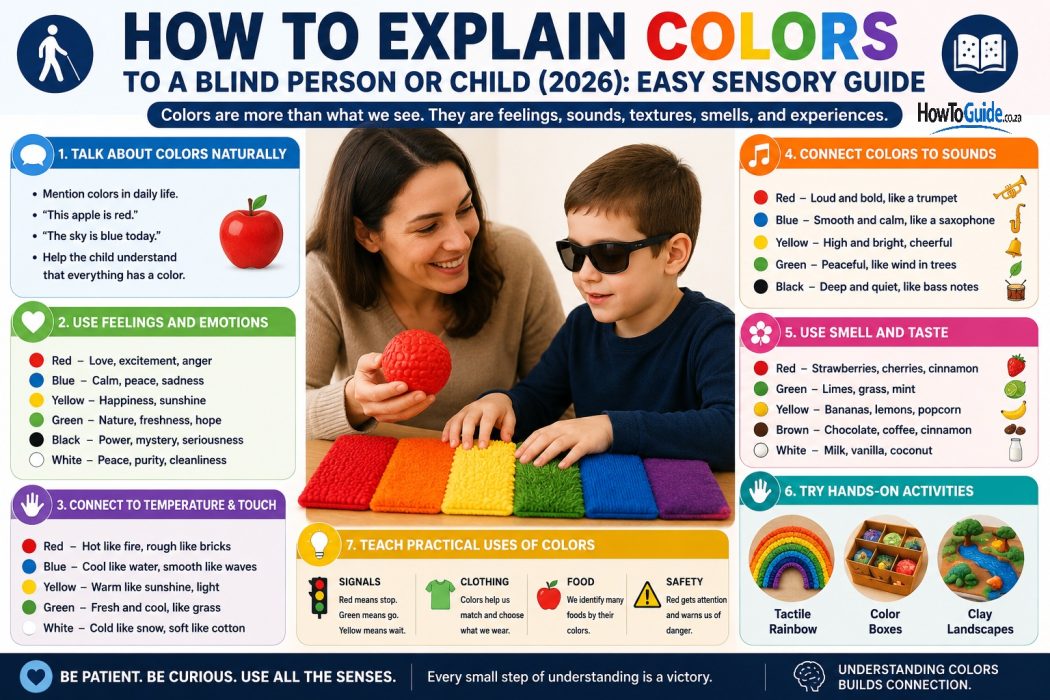
Step 1: Talk About Colors Naturally
Avoid avoiding the topic of colors.
Use color words in everyday conversations just as you would with anyone else.
For example:
- “This apple is red.”
- “The grass is green.”
- “The sky is blue.”
- “Your shirt is white.”
Over time, these conversations help build familiarity with how colors are used.
Step 2: Explain Colors Using Feelings
Many colors are associated with emotions.
For example:
| Color | Common Feeling |
|---|---|
| Red | Love, excitement, danger |
| Blue | Calm, peace, sadness |
| Yellow | Happiness and joy |
| Green | Nature and hope |
| Orange | Energy and fun |
| Purple | Creativity |
| Black | Mystery and strength |
| White | Peace and cleanliness |
You might say:
“Red feels like sitting close to a warm fire.”
or
“Blue feels peaceful, like relaxing beside a quiet river.”
Step 3: Use Temperature
Temperature provides another simple comparison.
Examples include:
- Red feels hot like fire.
- Orange feels warm like afternoon sunshine.
- Yellow feels warm like sunlight on your skin.
- Blue feels cool like water.
- Green feels fresh after rain.
- White feels cold like snow.
- Black feels warm after sitting in the sun.
Step 4: Use Touch
Touch is one of the most effective teaching tools.
You could associate colors with textures such as:
| Color | Texture |
|---|---|
| Red | Rough brick |
| Blue | Smooth glass |
| Green | Soft leaves |
| Yellow | Warm sand |
| Brown | Tree bark |
| White | Cotton |
| Black | Smooth stone |
Step 5: Explain Colors Through Sound
Sounds can also help create meaningful associations.
For example:
- Red sounds loud like a trumpet.
- Yellow sounds cheerful like birds singing.
- Blue sounds gentle like ocean waves.
- Green sounds peaceful like wind through trees.
- Black sounds deep like a drum.
- White sounds quiet after fresh snowfall.
Step 6: Use Smell and Taste
Smells and tastes create lasting memories.
Examples include:
| Color | Smell or Taste |
|---|---|
| Red | Strawberries, cherries |
| Orange | Oranges |
| Yellow | Lemons, bananas |
| Green | Mint, fresh grass |
| Brown | Chocolate, coffee |
| White | Milk, vanilla |
Step 7: Use Practical Activities
Learning by doing often works best.
Try activities such as:
Create a Sensory Rainbow
Use different textured materials for each color.
Examples:
- Cotton
- Sandpaper
- Leaves
- Foam
- Fabric
- Clay
Allow the learner to touch each section while discussing the associated color.
Make Color Boxes
Fill containers with objects connected to one color.
Example:
Red Box
- Strawberry scent
- Warm cloth
- Rough brick
Green Box
- Leaves
- Mint
- Grass
Build Clay Landscapes
Create rivers, mountains, beaches, and forests using modeling clay while describing each area and its associated color.
Step 8: Explain How Colors Help in Everyday Life
Colors have practical meanings beyond appearance.
Examples include:
Traffic Lights
- Red means stop.
- Yellow means prepare to stop.
- Green means go.
Clothing
Explain why some clothing colors are commonly matched together.
Food
Many foods are identified by their color.
Examples include:
- Red apples
- Yellow bananas
- Green spinach
Safety
Many warning signs use red because it attracts attention quickly.
5. My Experience or Practical Insights
I don’t personally experience blindness or teach colors firsthand, so I can’t claim personal experience. However, educational resources and insights shared by blind advocates consistently suggest that the most effective approach is to focus on experiences rather than visual descriptions.
Using familiar sensations such as warmth, textures, sounds, smells, and emotions often provides a more meaningful understanding than trying to describe what a color “looks like.” Every blind person learns differently, so patience, curiosity, and open conversation are usually more valuable than finding a single perfect explanation.
6. Common Mistakes to Avoid
Avoid these common mistakes.
Using Only Visual Comparisons
Saying:
“Blue is like the sky.”

may not be meaningful to someone born blind.
Instead, explain what blue represents or how people commonly associate it with calmness.
Giving Too Much Information
Teach one color at a time.
Start with basic colors such as:
- Red
- Blue
- Yellow
Then gradually introduce additional colors.
Ignoring Cultural Differences
Different cultures associate colors with different meanings.
For example, white may symbolize celebration in one culture and mourning in another.
Assuming There’s Only One Correct Explanation
There is no perfect way to explain colors.
Every learner develops understanding differently.
7. Troubleshooting
The child doesn’t seem interested.
Keep lessons short and use activities they enjoy.
They ask, “What does blue actually look like?”
Be honest. Explain that colors are visual experiences for sighted people but can also represent feelings, temperatures, sounds, and ideas.
They become frustrated.
Take a break and return to the topic later using different examples.
My explanations don’t seem to make sense.
Try using objects the learner already knows well through touch, smell, sound, or taste.
I’m unsure how much detail to give.
Start simple and build on previous conversations over time.
8. Helpful Tips and Best Practices
- Talk about colors naturally in everyday life.
- Encourage questions.
- Let the learner explore objects through multiple senses.
- Use familiar experiences rather than abstract descriptions.
- Repeat ideas often.
- Respect that every blind person understands colors differently.
- Be patient and flexible.
- Focus on understanding rather than memorisation.
9. Frequently Asked Questions
1. Can a blind person understand colors?
Yes. Although someone born blind cannot see colors, they can understand what colors represent through emotions, touch, sound, smell, taste, temperature, and everyday experiences.
2. Is it easier for someone who lost their sight later in life?
Generally, yes. People who once had vision may remember colors from earlier in life, while those born blind build their understanding through non-visual experiences.
3. Which colors are easiest to explain?
Red, yellow, and blue are often the easiest because they have strong emotional, physical, and everyday associations.
4. Should I avoid talking about colors?
No. Including colors in everyday conversations helps build understanding and supports communication with sighted people.
5. Is there technology that can help?
Yes. Some assistive technologies convert visual information into sounds or tactile feedback, helping users interpret objects, shapes, and sometimes colors.
6. Why is learning about colors important?
Understanding colors can help blind people communicate with others, understand stories, choose clothing, recognise safety information, shop more confidently, and participate more fully in everyday conversations.
10. Official Resources and References
For additional information, explore these trusted resources:
- National Institutes of Health (NIH) – Research on sensory substitution and assistive technologies.
- National Braille Press – Guidance for teaching blind children and adults.
- Perkins School for the Blind – Educational resources for learners with visual impairments.
- WonderBaby.org – Practical advice for parents and caregivers.
- First-hand educational perspectives shared by blind advocates such as Tommy Edison and Deborah Kent.
11. Conclusion
Explaining colors to a blind person is not about replacing vision. It is about helping someone understand the meaning, purpose, and associations of colors through experiences they already know.
By using touch, sound, smell, taste, temperature, emotions, and everyday conversations, you can build meaningful connections that make the world easier to understand. There is no perfect explanation for every person, and that’s perfectly okay. The goal is to communicate with patience, respect, and kindness while recognising that every blind person experiences and learns about the world in their own unique way.
12. Disclaimer
Disclaimer: This article is for educational purposes only. It does not replace advice from doctors, psychologists, occupational therapists, teachers of learners with visual impairment, orientation and mobility specialists, or other qualified professionals. Every blind person experiences the world differently. Always respect the individual’s comfort, experience, preferences, and learning style, and seek professional guidance where appropriate.

.
About Pheto M
Pheto M is the founder and guide writer of HowToGuide.co.za, a practical information website created to help people find clear, useful and easy-to-understand guidance on everyday topics.
Pheto started HowToGuide.co.za after noticing a common problem: people often need help with important questions, applications, services and everyday decisions, but the information available online can be confusing, difficult to understand or scattered across different sources.
Pheto has experience and knowledge across several areas, including Business, Information Technology (IT), Education and Relationships. These areas have given her a practical understanding of different challenges people face in their personal, professional and everyday lives.
Today, she dedicates her time to researching, writing and updating practical guides designed to help readers understand information and take the right steps with greater confidence.
Her approach is simple: make complex information simple, confusing processes clear, and difficult situations easier to manage.
Through HowToGuide.co.za, Pheto aims to provide practical, accessible and helpful information that readers can use in their everyday lives.
Pheto values feedback from readers and is committed to continually improving the content on HowToGuide.co.za. If you have a question, suggestion, or would like to get in touch, you can email her at admin@howtoguide.co.za. She personally reviews reader feedback and aims to respond within 48 hours.
How to Register a Customary Marriage in South Africa Before the 31 August 2026 Deadline
August 9, 2026
Reading Time: 11 minutesRegister your customary marriage in South Africa before the 31 August 2026 deadline. Learn about required documents, family witnesses, and Home Affairs steps.
How to Explain Colors to a Blind Person or Child (2026): A Sensory Guide
July 26, 2026
Reading Time: 5 minutesExplaining color to someone who is blind might sound impossible, but colors are far more than just visual—they are felt, heard, tasted, and experienced. Discover practical, sensory-rich ways to introduce color concepts to blind children or adults using everyday touch, temperature, emotion, and sound.
How to Change a Tire (Tyre) Safely: A Step-by-Step Guide for Beginners(2026).
July 23, 2026
Reading Time: 6 minutesLearn how to change a flat tire (tyre) safely with this easy, step-by-step guide for beginners. Discover the essential tools you need, clear instructions to replace your tire, common mistakes to avoid, and key safety tips for the road.
How to Stop Gambling and Save Money in 2026: A Practical Step-by-Step Guide
July 21, 2026
Reading Time: 6 minutesLearn how to stop gambling and protect your income. Explore step-by-step methods to calculate your true gambling costs, replace bad habits, and build a lasting savings plan.
Deep Questions to Ask Your Partner for a Stronger Relationship (2026)
July 14, 2026
Reading Time: 5 minutesEvery relationship reaches a point where everyday conversations are no longer enough. Strong, unshakable bonds aren’t built by accident—they are built through honest conversations, trust, and a willingness to hear difficult truths. This comprehensive guide features 10 sections of intentional, deep questions designed to help couples move past surface-level talk, explore emotional intimacy, and establish regular “love meetings” for lasting connectio
How to Deal With Grief: A Simple Step-by-Step Guide to Healing
July 10, 2026
Reading Time: 6 minutesLearn how to deal with grief with this simple, step-by-step guide. Discover practical coping tools, understand your emotions, and find your way to a new normal.
How to Pray: A Step-by-Step Biblical Guide for Beginners (2026
July 8, 2026
Reading Time: 7 minutesWhether you are new to prayer or looking to deepen your spiritual life, this comprehensive, step-by-step guide breaks down how to pray using Bible-recommended patterns. From preparing your heart and mastering the Lord’s Prayer to applying the practical ACTS method, discover actionable steps, situational prayers, and a 5-minute daily cheat sheet to help you build a consistent and meaningful conversation with God.