
1. Introduction
If you entered into a customary marriage in South Africa but never registered it with the Department of Home Affairs, 31 August 2026 is an important date to remember.
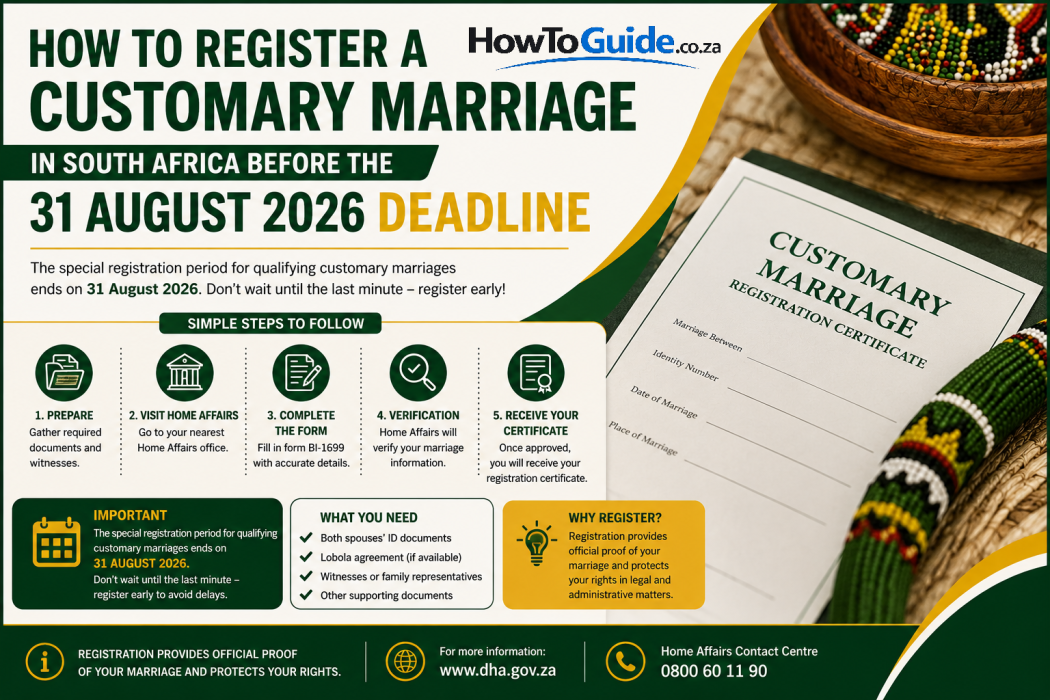
The Department of Home Affairs has confirmed that a special registration period for qualifying customary marriages runs from 1 September 2024 to 31 August 2026. The special period was introduced to give couples an opportunity to regularise customary marriages that were not registered within the prescribed period. It covers qualifying customary marriages concluded both before and after the Recognition of Customary Marriages Act came into operation in November 2000.
This means couples who have not yet registered their customary marriage should act as soon as possible rather than waiting for the final days of August.
Registering the marriage creates official documentary proof of the union. This can be particularly important when dealing with matters such as inheritance, estates, property and other legal or administrative processes. The Department of Justice also explains that registration provides prima facie proof of the existence of the customary marriage.
This guide explains what you need, where to go, what happens during the registration process, common problems to avoid and what to do if you experience difficulties.
Important: The 31 August 2026 date refers to the current special registration period. It should not be interpreted as meaning that every unregistered customary marriage automatically becomes invalid after that date. Section 4(9) of the Recognition of Customary Marriages Act states that failure to register does not affect the validity of a customary marriage.

2. Who This Guide Is For
This guide is intended for people in South Africa who:
- Entered into a customary marriage but never registered it with Home Affairs.
- Were married under customary law before November 2000.
- Entered into a customary marriage after November 2000 but did not register it within the required period.
- Need official proof of an existing customary marriage.
- Want to regularise their marital records before the 31 August 2026 special registration deadline.
- Are unsure which documents or family representatives are required.
- Are experiencing difficulties proving that a customary marriage took place.
The special registration period specifically applies to qualifying marriages that were not registered within the prescribed timeframe. Home Affairs has urged qualifying couples not to wait until the last minute because queues and processing delays may occur.
3. Requirements
Before going to Home Affairs, prepare as much supporting information as possible.
Basic requirements
A customary marriage entered into after the Recognition of Customary Marriages Act came into operation generally requires that:
- Both prospective spouses were at least 18 years old, subject to the provisions of the Act relating to minors.
- Both spouses consented to the marriage.
- The marriage was negotiated, entered into or celebrated in accordance with customary law.
The Department of Justice notes that lobola is not itself a legal requirement for the validity of a customary marriage. However, evidence relating to lobola negotiations or payment can help demonstrate that the marriage was negotiated according to custom.
Documents and people to prepare
According to the Department of Justice’s guidance, registration generally involves:
- Both spouses.
- Copies of the spouses’ valid identity documents.
- A lobola agreement, if available.
- At least one witness from the bride’s family.
- At least one witness from the groom’s family.
- Alternatively, representatives of the respective families where applicable.
- Parents may also need to be involved where a spouse was a minor at the time of the marriage.
It is sensible to take original documents as well as copies where possible.
You should also gather any other evidence that may help establish the marriage, such as:
- Lobola negotiation documents.
- Written family agreements.
- Traditional marriage documentation.
- Names and contact details of people who witnessed the marriage negotiations or celebration.
- Evidence relating to the date and place of the marriage.
- Previous correspondence concerning the customary marriage.
The exact supporting documents required can vary depending on the circumstances of the marriage, so it is advisable to confirm requirements with your nearest Home Affairs office.
4. Step-by-Step Guide to Registering a Customary Marriage
Step 1: Confirm that your marriage qualifies
First, establish that you entered into a customary marriage that was negotiated, entered into or celebrated according to applicable customary law.
For marriages entered into after the Recognition of Customary Marriages Act commenced, the spouses generally need to have consented to the marriage and met the requirements set out in the Act.
If your situation involves a complicated family history, multiple customary marriages, a deceased spouse or a dispute about whether the marriage existed, you may need additional assistance.
Step 2: Gather your identity documents
Both spouses should prepare copies of their valid identity documents.
Do not wait until you are at Home Affairs to discover that an important document is missing.
Create a simple folder containing:
- Your original ID.
- Your spouse’s original ID.
- Copies of both IDs.
- Lobola documentation, if available.
- Supporting marriage evidence.
- Relevant family or witness information.
Keeping everything together can make the process easier.
Step 3: Prepare your family representatives or witnesses
One of the practical differences between registering a customary marriage and dealing with some other administrative processes is the importance of evidence from the families.
The Department of Justice indicates that the spouses should present themselves together with at least one witness from each family and/or representatives of each family.
Therefore, speak to your families before visiting Home Affairs.
Make sure the people accompanying you:
- Know about the customary marriage.
- Know approximately when it took place.
- Understand their role.
- Have appropriate identification documents where required.
This can prevent a situation where you arrive at Home Affairs but cannot complete the registration because an important representative is unavailable.
Step 4: Visit a Home Affairs office
Customary marriages can be registered at a Department of Home Affairs office.
The Department of Justice also states that registration may be done through a designated traditional leader in areas where there is no Home Affairs office.
Because the special registration deadline is approaching, it is advisable to contact or visit the relevant office as early as possible.
Do not assume that arriving on 31 August will guarantee that your application will be completed that day.
Step 5: Complete the customary marriage registration form
The Department of Justice identifies BI-1699 as the form used to register a customary marriage.
The registering officer will require information about the marriage and the spouses.
Answer the questions carefully.
Check:
- Names.
- ID numbers.
- Marriage date.
- Marriage details.
- Spelling of surnames.
- Information concerning lobola, where applicable.
- Family and witness information.
A small error in personal information can create problems later when you need proof of the marriage.
Step 6: Allow Home Affairs to verify the marriage
The registering officer must be satisfied that the spouses entered into a valid customary marriage before registration can take place.
The Recognition of Customary Marriages Act allows the registering officer to require information necessary to establish the existence of the marriage.
This is why it is important to bring supporting evidence and appropriate family representatives.
If Home Affairs is satisfied that the marriage is valid, it can register the marriage and issue a certificate of registration.
Step 7: Keep proof that you applied
The Department of Justice states that an acknowledgement of receipt, BI-1700, is issued during the registration process.
Keep all documentation given to you by Home Affairs.
Take photographs or make copies of important documents if appropriate.
Do not throw away your receipt simply because you expect the final certificate to arrive later.
Step 8: Obtain your marriage certificate
Once the customary marriage has been registered, the registration certificate provides official documentary proof of the marriage.
The Department of Justice explains that a certificate of registration constitutes prima facie proof of the existence of the customary marriage and the information recorded on the certificate.
Check the certificate carefully when you receive it.
Look for errors involving:
- Your name.
- Your spouse’s name.
- Identity numbers.
- Date of marriage.
- Other important particulars.
If you identify an error, ask the relevant Home Affairs office about the correction process.
5. Practical Insights
One of the biggest practical lessons when registering a customary marriage is not to leave the process until the deadline.
Home Affairs itself has warned that waiting until the final days could result in unnecessary queues and delays.
A useful approach is to treat the process like a document-verification exercise.
Before going to Home Affairs, make a checklist:
Couple
- Both spouses available
- Both IDs available
- Copies of IDs prepared
Family
- Bride’s family representative/witness
- Groom’s family representative/witness
- Identification documents where required
Marriage evidence
- Lobola agreement, if available
- Evidence of negotiations
- Marriage celebration information
- Other supporting documents
Home Affairs
- Registration form/process confirmed
- Receipt retained
- Certificate checked when issued
This preparation can reduce unnecessary trips.
Another important point is that lobola should not be confused with the entire legal test for a valid customary marriage. The Department of Justice specifically states that lobola is not a requirement for validity, although evidence of lobola negotiations may assist in proving that negotiations took place according to custom.
6. Common Mistakes to Avoid
Mistake 1: Waiting until 31 August 2026
This is one of the biggest risks.
Home Affairs has specifically warned qualifying couples not to wait until the last minute.
Better approach: Start immediately.
Mistake 2: Assuming lobola alone proves the marriage
Lobola evidence can be useful, but it is not the only consideration.
A valid customary marriage involves other requirements, including consent and compliance with applicable customary law.
Mistake 3: Arriving without family representatives
Family witnesses or representatives may be important when establishing the circumstances of a customary marriage.
Check the requirements with Home Affairs before your appointment or visit.
Mistake 4: Taking only one copy of documents
It is safer to have copies available rather than having to leave the office to find a photocopy service.
Mistake 5: Giving inconsistent information
Make sure you and your spouse agree on important details such as:
- Date of marriage.
- Place of marriage.
- Names of family representatives.
- Details of negotiations.
- Other relevant information.
Inconsistent information can complicate verification.
Mistake 6: Assuming non-registration automatically means the marriage is invalid
This is an important legal distinction.
Section 4(9) of the Recognition of Customary Marriages Act provides that failure to register a customary marriage does not affect the validity of the marriage. However, registration is important because it provides official proof of the marriage and can be critical in legal and administrative matters.
7. Troubleshooting
What if Home Affairs says you do not have enough documents?
Ask the official exactly which additional documents or evidence are required.
Do not simply leave without understanding what you need to bring back.
Write down:
- The name or description of the missing document.
- Whether an original or copy is required.
- Whether witnesses must return.
- Whether a sworn statement is required.
- Whether additional family evidence is necessary.
Then return with the requested information.
What if one spouse cannot attend?
This can depend on the circumstances.
Because customary marriage registration involves establishing the existence of the marriage, you should contact Home Affairs and explain the situation before making the trip.
Do not assume that a relative can automatically substitute for an absent spouse.
What if one spouse has died?
A deceased spouse can make registration considerably more complicated because Home Affairs may need evidence establishing that the customary marriage existed.
Gather as much supporting evidence as possible and seek guidance from Home Affairs or an appropriate legal professional.
What if the marriage is disputed?
If family members disagree about whether a customary marriage took place, registration may become more complicated.
The Recognition of Customary Marriages Act provides mechanisms for enquiries into the existence of a marriage, and courts can also order registration in appropriate circumstances.
For a serious dispute, consider obtaining legal advice rather than relying only on informal family discussions.
What if Home Affairs refuses to register the marriage?
The Act provides that if the registering officer is not satisfied that a valid customary marriage was entered into, the officer may refuse registration.
The Act also provides for court applications concerning registration, cancellation or rectification in appropriate circumstances.
Ask for the reason for the refusal and keep any documentation provided.
8. Helpful Tips and Best Practices
Start before the deadline
The most important practical advice is simple: do not wait until 31 August 2026.
The special registration period has been running since 1 September 2024, and Home Affairs has now issued a specific reminder because the closing date is approaching.
Keep a document folder
Keep your marriage-related documents in one place.
Include copies of:
- IDs.
- Registration documents.
- Lobola agreements.
- Receipts.
- Home Affairs correspondence.
- Marriage certificates.
Make digital backups
Take clear photographs or scans of important documents and store them somewhere secure.
Check names carefully
Your marriage certificate should contain correct personal information.
Check spelling and ID numbers carefully.
Do not rely on social media information
Marriage-registration requirements can change.
For the latest information, use official government sources or speak directly to Home Affairs.
Ask questions at Home Affairs
If an official tells you that something is missing, ask exactly what is required.
Getting a precise answer can save you another unnecessary trip.
Keep your registration certificate safe
The certificate may become important years later when dealing with estates, inheritance, property or other legal matters.
9. Frequently Asked Questions
1. What is the deadline to register a customary marriage in South Africa in 2026?
The current special registration period ends on 31 August 2026. Home Affairs has urged qualifying couples to register before this date.
2. Can I register a customary marriage after the normal three-month period?
The Recognition of Customary Marriages Act generally requires marriages entered into after the Act commenced to be registered within three months, or within a longer period prescribed by the Minister. The current special registration period extends the relevant registration period to 31 August 2026 for qualifying marriages.
3. Does a customary marriage become invalid if it is not registered?
No. Section 4(9) of the Recognition of Customary Marriages Act states that failure to register a customary marriage does not affect its validity. However, registration is extremely important because the certificate provides official proof of the marriage.
4. Do I need a lobola agreement to register my customary marriage?
A lobola agreement can be useful supporting evidence, but lobola itself is not a requirement for the validity of a customary marriage.
5. Where can I register a customary marriage?
Customary marriages can be registered at a Department of Home Affairs office. The Department of Justice also states that registration may be done through a designated traditional leader in areas where there is no Home Affairs office.
6. Do both spouses have to attend?
The Department of Justice’s registration guidance states that the spouses should present themselves together with appropriate witnesses or family representatives. If one spouse cannot attend, contact Home Affairs first and explain the circumstances rather than assuming another person can automatically act on their behalf.
7. What form is used to register a customary marriage?
The Department of Justice identifies BI-1699 as the form used for customary marriage registration.
8. What proof do I receive after applying?
The Department of Justice identifies BI-1700 as an acknowledgement of receipt issued during the registration process. Once the marriage is registered, a registration certificate is issued.
9. Why is registration important if the marriage is already valid?
Registration creates official documentary proof of the marriage. This can be particularly important when dealing with inheritance, estates, property and other legal or administrative matters.
10. What should I do if my registration is refused?
Ask Home Affairs for the reason for the refusal and what evidence is required. The Recognition of Customary Marriages Act also provides for court applications concerning the registration of customary marriages in appropriate circumstances.
10. Official Resources and References
For the most reliable information, use official South African government resources.
Department of Home Affairs
The Department of Home Affairs is responsible for the registration of marriages, including customary marriages.
South African Government – Getting Married
The government’s marriage services page provides information about civil marriages, customary marriages and civil unions.
South African Government: Getting Married
Department of Justice – Customary Marriages
The Department of Justice provides information about the requirements for customary marriages, registration procedures and the Recognition of Customary Marriages Act.
Department of Justice: Customary Marriages
Recognition of Customary Marriages Act 120 of 1998
The Act establishes the legal framework for the recognition, registration and regulation of customary marriages in South Africa.
Recognition of Customary Marriages Act – South African Government
11. Conclusion
If you have a customary marriage that has never been registered, now is the time to act.
The Department of Home Affairs has confirmed that the special registration period ends on 31 August 2026. The period was created to help qualifying couples regularise customary marriages that were not registered within the prescribed period.
Do not wait until the final day.
Start by gathering your identity documents, marriage evidence, lobola documentation if available, and appropriate family representatives or witnesses. Then contact or visit your nearest Home Affairs office to confirm the current process and supporting documents required.
Most importantly, understand the difference between registration and validity. An otherwise valid customary marriage does not automatically become invalid simply because it was not registered. However, having official registration provides valuable proof of the marriage and can make future legal and administrative processes much easier.
If you qualify for the current special registration period, completing the process before 31 August 2026 is the safest approach.
12. Disclaimer
This article is provided for general informational and educational purposes only. It is not legal advice and does not replace advice from a qualified South African attorney, legal practitioner or the Department of Home Affairs.
Customary marriages can involve complex questions concerning family negotiations, consent, lobola, multiple marriages, matrimonial property, deceased spouses and disputed marriages. Requirements may also depend on the specific circumstances of a marriage.
Always confirm the latest requirements directly with the Department of Home Affairs or obtain professional legal advice where necessary.

.
About Pheto M
Pheto M is the founder and guide writer of HowToGuide.co.za, a practical information website created to help people find clear, useful and easy-to-understand guidance on everyday topics.
Pheto started HowToGuide.co.za after noticing a common problem: people often need help with important questions, applications, services and everyday decisions, but the information available online can be confusing, difficult to understand or scattered across different sources.
Pheto has experience and knowledge across several areas, including Business, Information Technology (IT), Education and Relationships. These areas have given her a practical understanding of different challenges people face in their personal, professional and everyday lives.
Today, she dedicates her time to researching, writing and updating practical guides designed to help readers understand information and take the right steps with greater confidence.
Her approach is simple: make complex information simple, confusing processes clear, and difficult situations easier to manage.
Through HowToGuide.co.za, Pheto aims to provide practical, accessible and helpful information that readers can use in their everyday lives.
Pheto values feedback from readers and is committed to continually improving the content on HowToGuide.co.za. If you have a question, suggestion, or would like to get in touch, you can email her at admin@howtoguide.co.za. She personally reviews reader feedback and aims to respond within 48 hours.
How to Register a Customary Marriage in South Africa Before the 31 August 2026 Deadline
August 9, 2026
Reading Time: 11 minutesRegister your customary marriage in South Africa before the 31 August 2026 deadline. Learn about required documents, family witnesses, and Home Affairs steps.
How to Explain Colors to a Blind Person or Child (2026): A Sensory Guide
July 26, 2026
Reading Time: 5 minutesExplaining color to someone who is blind might sound impossible, but colors are far more than just visual—they are felt, heard, tasted, and experienced. Discover practical, sensory-rich ways to introduce color concepts to blind children or adults using everyday touch, temperature, emotion, and sound.
How to Change a Tire (Tyre) Safely: A Step-by-Step Guide for Beginners(2026).
July 23, 2026
Reading Time: 6 minutesLearn how to change a flat tire (tyre) safely with this easy, step-by-step guide for beginners. Discover the essential tools you need, clear instructions to replace your tire, common mistakes to avoid, and key safety tips for the road.
How to Stop Gambling and Save Money in 2026: A Practical Step-by-Step Guide
July 21, 2026
Reading Time: 6 minutesLearn how to stop gambling and protect your income. Explore step-by-step methods to calculate your true gambling costs, replace bad habits, and build a lasting savings plan.
Deep Questions to Ask Your Partner for a Stronger Relationship (2026)
July 14, 2026
Reading Time: 5 minutesEvery relationship reaches a point where everyday conversations are no longer enough. Strong, unshakable bonds aren’t built by accident—they are built through honest conversations, trust, and a willingness to hear difficult truths. This comprehensive guide features 10 sections of intentional, deep questions designed to help couples move past surface-level talk, explore emotional intimacy, and establish regular “love meetings” for lasting connectio
How to Deal With Grief: A Simple Step-by-Step Guide to Healing
July 10, 2026
Reading Time: 6 minutesLearn how to deal with grief with this simple, step-by-step guide. Discover practical coping tools, understand your emotions, and find your way to a new normal.
How to Pray: A Step-by-Step Biblical Guide for Beginners (2026
July 8, 2026
Reading Time: 7 minutesWhether you are new to prayer or looking to deepen your spiritual life, this comprehensive, step-by-step guide breaks down how to pray using Bible-recommended patterns. From preparing your heart and mastering the Lord’s Prayer to applying the practical ACTS method, discover actionable steps, situational prayers, and a 5-minute daily cheat sheet to help you build a consistent and meaningful conversation with God.