
Introduction
Applying to university is one of the biggest decisions you will ever make. I still remember applying to university about 13 years ago. Like many matric students, I felt excited but also nervous. There were application forms to complete, documents to certify, deadlines to remember, and questions about whether I qualified for my chosen course.
Looking back, I realised that applying was not actually difficult—the confusing part was knowing where to start.
That’s why I created this guide.
Whether you’re currently in matric, you’ve already finished school, or you’re planning to study further after completing another qualification, this guide explains everything in simple English.
By the end of this article, you’ll know:
- How to apply to any South African public university
- The documents you’ll need before applying
- Important deadlines you should never miss
- Common mistakes that cause applications to be rejected
- Practical tips to improve your chances of success
- A ranking of South Africa’s public universities to help you choose where to apply
Let’s get started.
Who This Guide Is For
This guide is suitable for:
- Current Grade 12 learners
- Students applying with Grade 11 results
- People taking a gap year
- Adults returning to study
- Students transferring between universities
- Honours, Master’s and PhD applicants
- International students applying to South African universities
Requirements Before You Apply
Before starting your application, make sure you have the following.
Academic Requirements
For undergraduate studies, you’ll generally need:
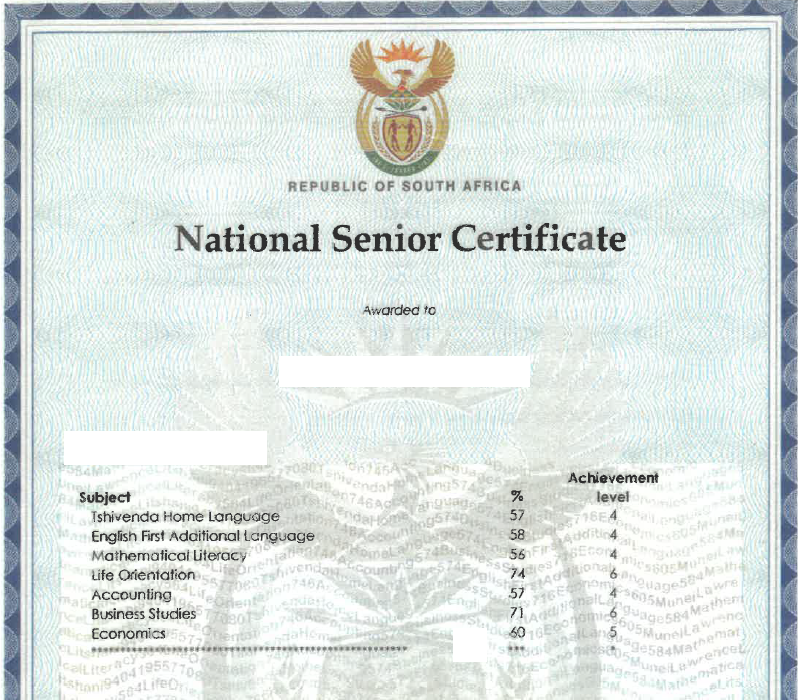
- National Senior Certificate (NSC) or equivalent
- Required APS score
- Required subjects for your chosen qualification
- Any additional faculty requirements
Some programmes also require:
- National Benchmark Tests (NBTs)
- Auditions
- Portfolios
- Interviews
- Practical assessments
For postgraduate studies, you may need:
- Relevant Bachelor’s or Honours degree
- Academic transcript
- CV
- Research proposal
- Letters of recommendation
Documents You’ll Need
Prepare clear PDF copies of:
- Certified South African ID or passport
- Grade 11 results (current matric students)
- NSC certificate (if completed matric)
- Academic transcripts
- Proof of residence (where required)
- Proof of payment for application fee
- Passport photo (some universities)
- SAQA evaluation (international qualifications)
- Portfolio (Art, Design, Architecture)
- Research proposal (Master’s/PhD)
Tip: Save all documents using simple filenames such as:
- ID.pdf
- Grade11.pdf
- Transcript.pdf
This makes uploading much easier.
Step-by-Step Guide
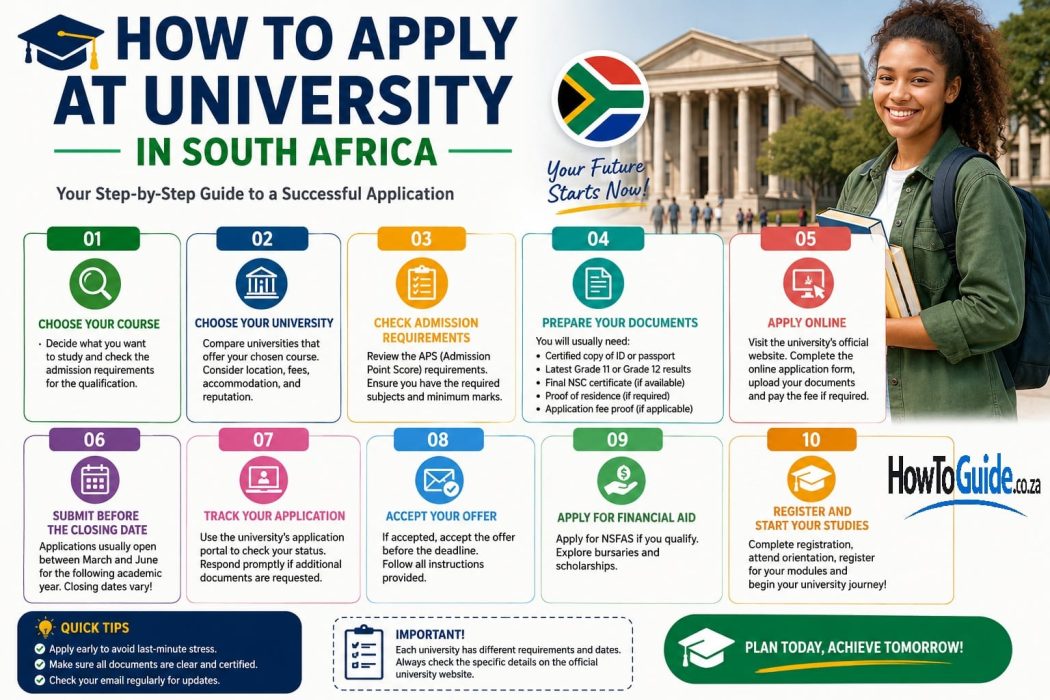
Step 1: Research Your Options
Choosing the right university is more important than choosing the highest-ranked university.
Ask yourself:

- What career interests me?
- Which degree do I need?
- Which universities offer it?
- Can I meet the APS requirements?
- Can I afford accommodation?
- Will I study full-time or online?
Visit university websites and attend open days whenever possible.
Step 2: Check Admission Requirements
Every university publishes admission requirements.
Check:
- APS score
- Required subjects
- Minimum marks
- Additional assessments
- Closing dates
Don’t assume requirements are the same across universities.
Example:
Engineering at one university may require:
- Mathematics 70%
- Physical Sciences 70%
Another university may accept slightly lower marks.
Step 3: Gather Your Documents
This is one of the most common reasons applications are delayed.
Collect everything before opening the application portal.
Most universities accept PDF files under approximately 2 MB.
Ensure every document is:
- Certified
- Easy to read
- Properly scanned
- Not cropped
Step 4: Complete the Online Application
Most universities now use online applications.
Typical process:
- Visit the official university website.
- Click Apply Online.
- Create an account.
- Verify your email.
- Complete personal details.
- Enter academic history.
- Choose your programmes.
- Upload supporting documents.
- Review everything carefully.
- Submit your application.
Double-check:
- ID number
- Names
- Date of birth
- Email address
- Cellphone number
Even a small mistake can delay processing.
Step 5: Pay the Application Fee
Many universities charge a once-off, non-refundable application fee.
Typical fees:
- South African applicants: around R150
- International applicants: may be R600 or more
Payment options usually include:
- EFT
- Bank deposit
- Online payment
Always use your student number or application reference as the payment reference.
Step 6: Submit Before the Deadline
Never wait until the final day.
University systems become extremely busy near closing dates.
Typical deadlines include:
| Programme | Typical Closing Period |
|---|---|
| Medicine | June |
| Health Sciences | June |
| Architecture | July |
| Arts & Design | July |
| Most undergraduate programmes | August–September |
| Postgraduate programmes | August–September |
Always confirm dates with your chosen university.
Step 7: Track Your Application
After submission:
- Save your student number.
- Save your password.
- Check your email regularly.
- Log into the student portal.
Possible application statuses include:
- Received
- Documents Outstanding
- Under Review
- Provisionally Accepted
- Waiting List
- Accepted
- Unsuccessful
If additional documents are requested, upload them immediately.
My Experience and Practical Insights
When I applied to university over 8 years ago, I discovered that preparation makes all the difference.
The biggest lesson I learned was not to leave everything until the last minute.
Some students waited until the closing date to certify documents or scan certificates. Others forgot their application passwords or uploaded blurry copies of their ID documents. These small mistakes caused unnecessary stress and, in some cases, delayed their applications.
If I could give one piece of advice, it would be this:
Start early.
Having everything ready before applications open makes the process much smoother and far less stressful.
Another lesson is not to focus only on the “top-ranked” universities. The best university is often the one that offers the programme you want, fits your budget, and provides the support you need to succeed.
South African Universities Ranked from Best to Lower
University rankings provide useful guidance, but they shouldn’t be the only factor in your decision. Consider programme quality, affordability, campus environment, location, graduate employability, and student support.
Top-Tier Universities
| Rank | University | Strengths |
|---|---|---|
| 1 | University of Cape Town (UCT) | Health Sciences, Law, Research |
| 2 | University of the Witwatersrand (Wits) | Medicine, Mining, Research |
| 3 | Stellenbosch University | Engineering, Agriculture, Business |
| 4 | University of Pretoria | Veterinary Science, Law, Economics |
Strong National Universities
| Rank | University |
|---|---|
| 5 | University of Johannesburg |
| 6 | University of KwaZulu-Natal |
| 7 | North-West University |
| 8 | University of South Africa (UNISA) |
Other Excellent Public Universities
- University of the Western Cape
- University of the Free State
- Rhodes University
- Nelson Mandela University
- Durban University of Technology
- Tshwane University of Technology
- Cape Peninsula University of Technology
- Central University of Technology
- Mangosuthu University of Technology
- University of Limpopo
- University of Venda
- Walter Sisulu University
- Sol Plaatje University
- University of Mpumalanga
- University of Fort Hare
- University of Zululand
- Sefako Makgatho Health Sciences University
- Vaal University of Technology
All 26 public universities are accredited and offer recognised qualifications.
Common Mistakes to Avoid
Avoid these common application errors:
- Waiting until the closing date
- Uploading blurry documents
- Using an incorrect email address
- Forgetting your password
- Applying for courses you don’t qualify for
- Missing application fees
- Ignoring university emails
- Entering incorrect subject marks
- Forgetting to submit supporting documents
- Applying to only one university
Troubleshooting
My application won’t submit
Check:
- Internet connection
- Required fields
- File sizes
- File formats
I forgot my password
Use the “Forgot Password” option on the university application portal.
My documents were rejected
Possible reasons include:
- Blurry scans
- Expired certification
- Incorrect document uploaded
- Missing pages
Upload corrected copies as soon as possible.
I missed the deadline
Unfortunately, most universities won’t accept late applications.
You can:
- Look for universities still accepting applications.
- Consider institutions that open late applications.
- Apply the following year.
- Explore TVET colleges or other accredited higher education institutions.
Helpful Tips and Best Practices
To improve your application experience:
- Apply to at least three universities.
- Keep digital and printed copies of everything.
- Check your email every few days.
- Use the same email address throughout the application process.
- Save all confirmation emails.
- Record your student numbers safely.
- Read every instruction carefully.
- Ask questions if you’re unsure.
- Apply as early as possible.
- Research bursaries and financial aid while applying.
Frequently Asked Questions
1. When should I apply to university?
Most applications open between March and April and close between June and September, depending on the university and programme.
2. Can I apply with Grade 11 results?
Yes. Most universities allow current matric learners to apply using their Grade 11 final results.
3. What is an APS score?
APS (Admission Points Score) is calculated using your matric subjects and marks. Every programme has its own minimum APS requirement.
4. Can I apply to multiple universities?
Yes. Applying to several universities increases your chances of receiving an offer.
5. Do I need to write the National Benchmark Tests (NBTs)?
Some universities and programmes require NBTs, although many institutions have changed their policies in recent years. Always check the latest requirements for your chosen programme.
6. How long does it take to receive an admission decision?
It varies. Some universities respond within a few weeks, while others take several months.
7. What happens if I’m accepted?
You’ll need to:
- Accept the offer
- Register
- Pay any required registration fees
- Attend orientation
- Enrol for your modules
8. What if I don’t get accepted?
Consider:
- Applying elsewhere
- Studying another qualification
- Upgrading your marks
- Applying again next year
Official Resources and References
For the latest admission information, consult:
- Official websites of South Africa’s 26 public universities
- Department of Higher Education and Training (DHET)
- Universities South Africa (USAf)
- National Student Financial Aid Scheme (NSFAS)
- South African Qualifications Authority (SAQA)
- National Benchmark Tests (where applicable)
Always rely on official sources rather than social media rumours or unofficial websites.
Conclusion
Applying to university may seem complicated at first, but breaking it down into manageable steps makes the process much easier.
Start preparing early, research your options carefully, gather your documents in advance, and apply to more than one university to maximise your chances of success. While university rankings can help you compare institutions, the best university for you is the one that aligns with your career goals, academic strengths, financial situation, and personal preferences.
Remember these key points:
- Start your applications as early as possible.
- Check admission requirements carefully.
- Prepare all supporting documents before applying.
- Meet every application deadline.
- Monitor your application regularly through the student portal.
- Keep copies of all documents and correspondence.
With good planning and careful preparation, you’ll be well on your way to starting your higher education journey.
We wish you every success with your university applications and your future studies.
Disclaimer
This guide is intended for general informational purposes only and reflects the university application process in South Africa as understood in 2026. Admission requirements, APS scores, application fees, National Benchmark Test (NBT) requirements, programme availability, and closing dates differ between institutions and may change without notice. Always verify the latest information directly with the official university admissions office or website before submitting your application. Following this guide does not guarantee admission to any university or programme.

.
About Pheto M
Pheto M is the founder and guide writer of HowToGuide.co.za, a practical information website created to help people find clear, useful and easy-to-understand guidance on everyday topics.
Pheto started HowToGuide.co.za after noticing a common problem: people often need help with important questions, applications, services and everyday decisions, but the information available online can be confusing, difficult to understand or scattered across different sources.
Pheto has experience and knowledge across several areas, including Business, Information Technology (IT), Education and Relationships. These areas have given her a practical understanding of different challenges people face in their personal, professional and everyday lives.
Today, she dedicates her time to researching, writing and updating practical guides designed to help readers understand information and take the right steps with greater confidence.
Her approach is simple: make complex information simple, confusing processes clear, and difficult situations easier to manage.
Through HowToGuide.co.za, Pheto aims to provide practical, accessible and helpful information that readers can use in their everyday lives.
Pheto values feedback from readers and is committed to continually improving the content on HowToGuide.co.za. If you have a question, suggestion, or would like to get in touch, you can email her at admin@howtoguide.co.za. She personally reviews reader feedback and aims to respond within 48 hours.
Limpopo Online Admission Status Check 2027: Step-by-Step (Grade R,1& 8)
September 2, 2026
Reading Time: 9 minutesApplications for Limpopo Online Admissions 2027 are officially closed. Learn how to log into the portal, track your child’s application progress, check placement status, and resolve common login issues.
ACTOM EHS Internship 2026: Requirements & Application Guide. Closed on 31 August 2026
August 9, 2026
Reading Time: 9 minutesLooking to start your career in Environmental, Health, and Safety (EHS)? Explore the ACTOM Power Transformers EHS Internship 2026 in Wadeville. Learn about qualification requirements, key responsibilities, necessary application documents, and step-by-step instructions on how to apply before the 31 August 2026 closing date.
How to Register for Gauteng School Admissions Grade 1 & Grade 8 Online (2027)
August 5, 2026
Reading Time: 5 minutesLearn how to register for Gauteng school admissions (Grade 1 & Grade 8) online for 2027. Step-by-step GDE portal guide, required documents, and practical tips.
How to Register for SACE Online in South Africa (2026): Complete Step-by-Step Guide
August 4, 2026
Reading Time: 6 minutesLearn how to register for SACE online in South Africa. Follow our 2026 step-by-step guide on eServices, required documents, fees, and application steps.
Limpopo Online Admissions 2027: How to Apply for Grade R,1 & 8 (Step-by-Step Guide): Closed 31 August 2026
July 26, 2026
Reading Time: 6 minutesA complete step-by-step guide on how to apply for public school placement using the Limpopo Department of Education Online Learner Admissions System (OLAS) for the 2027 school year. Learn about opening and closing dates, required documents, registration steps, and common mistakes to avoid.
UIF Graduate Internship Programme (2027-2029): How to Apply for 109 Internship Opportunities. Closed
July 25, 2026
Reading Time: 4 minutesApply for the UIF Graduate Internship Programme 2026 (109 Posts). Earn an R8,174.75 monthly stipend. Get application emails, Z83 details, and step-by-step instructions before 7 August 2026.
How to Negotiate a Higher Salary in 2026: A Step-by-Step Guide
July 21, 2026
Reading Time: 5 minutesFeel like your hard work and loyalty are going unrewarded? Discover 5 step-by-step strategies to research your market value, prepare a convincing pitch, and negotiate a higher salary or better benefits package with confidence in 2026.
ATNS Graduate in Training Programme 2026 (24-Month Paid Internship): Closed
July 15, 2026
Reading Time: 5 minutesApply for the ATNS Graduate in Training Programme 2026. Discover 24-month paid graduate opportunities in Business, Logistics, Aviation Security, Information Management, and OHS based in Johannesburg. Closing date: 28 July 2026
Seriti Engineering Learnership 2026 (NVC071/26GS): Apply Online:Closed
July 13, 2026
Reading Time: 5 minutesWant to launch your engineering career in the mining sector? Apply for the Seriti Engineering Learnership 2026 (Reference: NVC071/26GS) at New Vaal Colliery. Discover the minimum N2/Grade 12 requirements, available trades (Diesel Mechanic & Auto Electrician), and follow our step-by-step application guide before the closing date on 21 July 2026.