
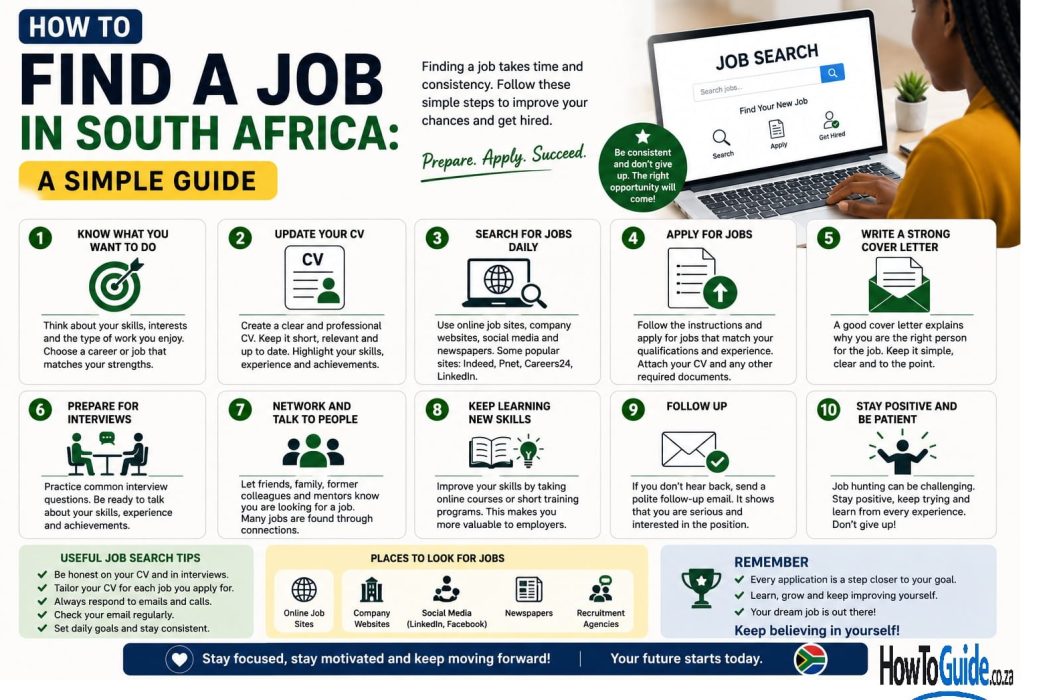
Simple English Guide | Step-by-Step Instructions | Practical Tips to Help You Find Work
1. Introduction
Finding a job in South Africa can be challenging. With high unemployment and thousands of people applying for the same vacancies, it is easy to feel discouraged. However, finding a job is not just about applying for as many vacancies as possible—it is about applying strategically.
Over the years, I have helped family members search for jobs, internships, learnerships, and graduate programmes. One lesson stands out above all others: the people who succeed are usually those who use the right platforms, apply consistently, and follow application instructions carefully.
Many job seekers only search on large job boards, but some of the best opportunities are advertised directly on company career pages or government employment portals.
This guide will show you where to look, how to prepare your applications, avoid scams, and improve your chances of getting hired.
2. Who This Guide Is For
This guide is suitable for:
- First-time job seekers
- School leavers
- Matric graduates
- University and TVET graduates
- Unemployed South Africans
- People changing careers
- Anyone looking for internships, learnerships, graduate programmes, or permanent employment
Whether you have experience or not, the steps in this guide can help you organise your job search more effectively.
3. Requirements
Before you begin applying, make sure you have the following:
- An updated CV
- A valid South African ID (or work permit if applicable)
- Copies of your qualifications
- A professional email address
- A working cellphone number
- Internet access (where possible)
- Certified copies of documents if requested by the employer
It is also helpful to have electronic copies of your documents saved as PDF files for online applications.
4. Step-by-Step Guide
Step 1: Decide What Type of Job You Want
There are several ways to enter the workforce.
These include:
- Permanent employment
- Temporary employment
- Learnerships
- Internships
- Graduate programmes
- Volunteer work
Choosing the right pathway helps you focus your job search.
Step 2: Register on Trusted Job Platforms
Create profiles on reputable employment websites and upload your CV.
Useful platforms include:
- SA Youth
- Employment Services of South Africa (ESSA)
- PNet
- CareerJunction
- Indeed
- Careers24
- Job Mail
Keep your profile complete and up to date.
Step 3: Visit Company Career Pages
One of the biggest mistakes job seekers make is relying only on job boards.
Many companies advertise vacancies on their own websites first.
Examples include:
- Shoprite Group
- Pick n Pay
- SPAR
- Woolworths
- Clicks Group
- Dis-Chem
- Boxer
- Mr Price Group
- Pepkor
- Massmart
Check these websites regularly and sign up for job alerts where available.
Step 4: Apply for Suitable Vacancies
Read every advertisement carefully.
Before submitting your application:
- Update your CV.
- Include all requested documents.
- Use the correct reference number if required.
- Follow the application instructions exactly.
Never send the same generic application to every employer.
Step 5: Prepare for Interviews
Once you receive an interview invitation:
- Research the company.
- Learn about the position.
- Dress neatly.
- Arrive early.
- Bring copies of your CV and supporting documents.
- Prepare answers for common interview questions.
Confidence comes from preparation.
Step 6: Keep Applying
Finding a job takes time.
Create a routine by:
- Searching for jobs daily.
- Tracking your applications.
- Following up where appropriate.
- Continuing to improve your skills while you search.
Consistency often leads to better results than applying for many jobs in a single day and then stopping.
5. My Experience and Practical Insights
From helping people search for jobs over the years, I have noticed a few common patterns.
Many applicants spend all their time on large job boards but never visit company career websites. Others apply for hundreds of vacancies using the same CV without tailoring it to the role.
The people who usually have more success are those who:
- Apply consistently rather than occasionally.
- Follow every instruction in the job advertisement.
- Keep their CV updated.
- Check company career pages regularly.
- Apply as soon as vacancies are advertised instead of waiting until the closing date.
Another lesson I have learned is that rejection is a normal part of job searching. Not receiving a response does not necessarily mean you are unqualified. Often, employers receive hundreds or even thousands of applications for a single vacancy.
Keep improving your applications and continue applying.
6. Common Mistakes to Avoid
Avoid these common mistakes:
- Using an outdated CV.
- Applying for jobs you do not qualify for.
- Ignoring application instructions.
- Missing application deadlines.
- Using an unprofessional email address.
- Forgetting to include supporting documents.
- Paying recruiters or employers for jobs.
- Giving personal information to unverified recruiters.
- Applying only on one website.
7. Troubleshooting
I never receive interview invitations.
Review your CV, ensure it matches the job requirements, and tailor it to each application.
I have no work experience.
Consider applying for learnerships, internships, volunteer opportunities, or entry-level retail positions that provide training.
I cannot find vacancies.
Expand your search by checking government portals, company career pages, recruitment agencies, and local job platforms.
I think I have found a fake job advertisement.
Do not send money or personal banking details. Verify the vacancy on the company’s official website.
I keep getting rejected.
Job searching is competitive. Continue improving your CV, build new skills, and keep applying consistently.
8. Helpful Tips and Best Practices
To improve your chances of finding employment:
- Apply early.
- Keep your CV updated.
- Use multiple job platforms.
- Visit company career pages regularly.
- Register for job alerts.
- Learn new digital or workplace skills.
- Practise interview questions.
- Keep copies of every application.
- Network with professionals.
- Stay positive and consistent.
Remember that every application is another opportunity.
9. Frequently Asked Questions
1. What is the fastest way to find a job in South Africa?
Use a combination of trusted job websites, government employment portals, company career pages, and professional networking platforms.
2. Can I get a job without Matric?
Yes. Some entry-level positions, particularly in retail, hospitality, cleaning, security, and general work, may not require Matric. Requirements differ between employers.
3. Can I get a job without experience?
Yes. Many learnerships, internships, graduate programmes, and entry-level jobs are designed for people with little or no work experience.
4. How often should I apply?
Apply regularly rather than waiting for the “perfect” job. Consistency increases your chances of success.
5. Should I have more than one CV?
Yes. Tailoring your CV for different industries or job types can improve your chances of being shortlisted.
6. Is LinkedIn important?
Yes. Many employers advertise vacancies and search for candidates on LinkedIn, particularly for professional and graduate roles.
7. What should I do if an employer asks for money?
Do not pay. Legitimate employers do not charge application, interview, training, or placement fees.
8. How long should my CV be?
Generally, two to three pages are sufficient for most job applications.
9. Should I follow up after applying?
If contact details are provided and enough time has passed, a polite follow-up can demonstrate your interest in the position.
10. What if I do not hear back?
Many employers receive a high volume of applications and only contact shortlisted candidates. Continue applying for other opportunities while waiting for responses.
10. Official Resources and References
The following trusted platforms can help you search for employment opportunities:
- SA Youth (SAYouth.mobi) – Free employment opportunities for young South Africans through the Presidential Youth Employment Initiative.
- Employment Services of South Africa (ESSA) – Government employment database for job seekers and employers.
- LinkedIn – Professional networking and recruitment platform.
- Indeed South Africa
- PNet
- CareerJunction
- Careers24
- Job Mail
You should also visit the official career pages of companies you are interested in working for, as many vacancies are advertised there before appearing on job boards.
11. Conclusion
Finding a job in South Africa requires patience, preparation, and persistence. Although competition is high, using the right strategy can significantly improve your chances of success.
Focus on trusted job platforms, visit company career pages regularly, tailor your CV to each application, prepare thoroughly for interviews, and never stop learning new skills.
Most importantly, do not become discouraged by rejection. Every application helps you gain experience and brings you one step closer to the right opportunity.
Stay consistent, keep improving, and continue applying.
12. Disclaimer
This guide is provided for informational purposes only. It is based on research, publicly available information, and practical experience in assisting job seekers. Employment requirements, recruitment processes, and vacancy information may change without notice.
Always verify vacancies through the official websites of employers, government departments, or recognised recruitment platforms before applying. Never pay any person or organisation that promises to guarantee you a job, interview, or employment opportunity. HowToGuide.co.za is not affiliated with any employer, recruitment agency, or government department mentioned in this guide.

.
About Pheto M
Pheto M is the founder and guide writer of HowToGuide.co.za, a practical information website created to help people find clear, useful and easy-to-understand guidance on everyday topics.
Pheto started HowToGuide.co.za after noticing a common problem: people often need help with important questions, applications, services and everyday decisions, but the information available online can be confusing, difficult to understand or scattered across different sources.
Pheto has experience and knowledge across several areas, including Business, Information Technology (IT), Education and Relationships. These areas have given her a practical understanding of different challenges people face in their personal, professional and everyday lives.
Today, she dedicates her time to researching, writing and updating practical guides designed to help readers understand information and take the right steps with greater confidence.
Her approach is simple: make complex information simple, confusing processes clear, and difficult situations easier to manage.
Through HowToGuide.co.za, Pheto aims to provide practical, accessible and helpful information that readers can use in their everyday lives.
Pheto values feedback from readers and is committed to continually improving the content on HowToGuide.co.za. If you have a question, suggestion, or would like to get in touch, you can email her at admin@howtoguide.co.za. She personally reviews reader feedback and aims to respond within 48 hours.
Limpopo Online Admission Status Check 2027: Step-by-Step (Grade R,1& 8)
September 2, 2026
Reading Time: 9 minutesApplications for Limpopo Online Admissions 2027 are officially closed. Learn how to log into the portal, track your child’s application progress, check placement status, and resolve common login issues.
ACTOM EHS Internship 2026: Requirements & Application Guide. Closed on 31 August 2026
August 9, 2026
Reading Time: 9 minutesLooking to start your career in Environmental, Health, and Safety (EHS)? Explore the ACTOM Power Transformers EHS Internship 2026 in Wadeville. Learn about qualification requirements, key responsibilities, necessary application documents, and step-by-step instructions on how to apply before the 31 August 2026 closing date.
How to Register for Gauteng School Admissions Grade 1 & Grade 8 Online (2027)
August 5, 2026
Reading Time: 5 minutesLearn how to register for Gauteng school admissions (Grade 1 & Grade 8) online for 2027. Step-by-step GDE portal guide, required documents, and practical tips.
How to Register for SACE Online in South Africa (2026): Complete Step-by-Step Guide
August 4, 2026
Reading Time: 6 minutesLearn how to register for SACE online in South Africa. Follow our 2026 step-by-step guide on eServices, required documents, fees, and application steps.
Limpopo Online Admissions 2027: How to Apply for Grade R,1 & 8 (Step-by-Step Guide): Closed 31 August 2026
July 26, 2026
Reading Time: 6 minutesA complete step-by-step guide on how to apply for public school placement using the Limpopo Department of Education Online Learner Admissions System (OLAS) for the 2027 school year. Learn about opening and closing dates, required documents, registration steps, and common mistakes to avoid.
UIF Graduate Internship Programme (2027-2029): How to Apply for 109 Internship Opportunities. Closed
July 25, 2026
Reading Time: 4 minutesApply for the UIF Graduate Internship Programme 2026 (109 Posts). Earn an R8,174.75 monthly stipend. Get application emails, Z83 details, and step-by-step instructions before 7 August 2026.
How to Negotiate a Higher Salary in 2026: A Step-by-Step Guide
July 21, 2026
Reading Time: 5 minutesFeel like your hard work and loyalty are going unrewarded? Discover 5 step-by-step strategies to research your market value, prepare a convincing pitch, and negotiate a higher salary or better benefits package with confidence in 2026.
ATNS Graduate in Training Programme 2026 (24-Month Paid Internship): Closed
July 15, 2026
Reading Time: 5 minutesApply for the ATNS Graduate in Training Programme 2026. Discover 24-month paid graduate opportunities in Business, Logistics, Aviation Security, Information Management, and OHS based in Johannesburg. Closing date: 28 July 2026
Seriti Engineering Learnership 2026 (NVC071/26GS): Apply Online:Closed
July 13, 2026
Reading Time: 5 minutesWant to launch your engineering career in the mining sector? Apply for the Seriti Engineering Learnership 2026 (Reference: NVC071/26GS) at New Vaal Colliery. Discover the minimum N2/Grade 12 requirements, available trades (Diesel Mechanic & Auto Electrician), and follow our step-by-step application guide before the closing date on 21 July 2026.