
Introduction
Paying for college can be one of the biggest challenges facing South African students. Fortunately, the National Student Financial Aid Scheme (NSFAS) helps thousands of deserving students each year by providing funding to study at public universities and TVET colleges.
If you plan to study at a public TVET college during Semester 2 of 2026, this funding could cover many of your study-related expenses, including tuition, accommodation (where applicable), learning materials, transport, and other allowances, depending on the type of funding you qualify for.
Applications for NSFAS 2026 TVET Semester 2 opened on 1 July 2026 and close on 17 July 2026. Missing the deadline could mean waiting until the next application cycle, so it is important to apply as early as possible.
In this guide, you’ll learn:
- Who qualifies for NSFAS
- The documents you’ll need
- How to apply online
- How to track your application
- What to do if your application is rejected
- Common mistakes to avoid
- Helpful tips to improve your chances of approval
Who This Guide Is For
This guide is designed for:
- First-time TVET college students
- Returning TVET students applying for Semester 2 funding
- South African citizens and permanent residents
- Students from low- and middle-income households
- Parents and guardians helping students apply
- SASSA beneficiaries planning to study
Whether you’re applying for a bursary or a student loan, this guide will help you understand the entire application process.
Requirements
Before applying, make sure you meet the eligibility requirements.
NSFAS Bursary
You may qualify if:
- You are a South African citizen or permanent resident.
- Your household income is R350,000 or less per year.
- If you have a disability, your household income is R600,000 or less.
- You will study at a public TVET college.
- You are a SASSA grant beneficiary (financial eligibility is automatically met).
NSFAS Student Loan
You may qualify if:
- Household income is between R350,001 and R600,000 annually.
- You are studying at a public TVET college.
- You meet the academic and citizenship requirements.
Documents Required
Prepare these before starting:
- Certified South African ID (Smart ID: front and back)
- Parent/guardian/spouse ID copies
- Proof of household income (if applicable)
- NSFAS Consent Form
- NSFAS Declaration Form (where applicable)
- Disability Annexure A Form (if applicable)
- Orphan/Vulnerable Child Declaration Form (if applicable)
- Proof of guardianship (if applicable)
- Academic records or latest results (where applicable)
Step-by-Step Guide
Step 1: Visit the Official NSFAS Website
Go to the official NSFAS website and start your application through the myNSFAS portal.
Only use the official website. NSFAS applications are free.
Step 2: Create Your myNSFAS Profile
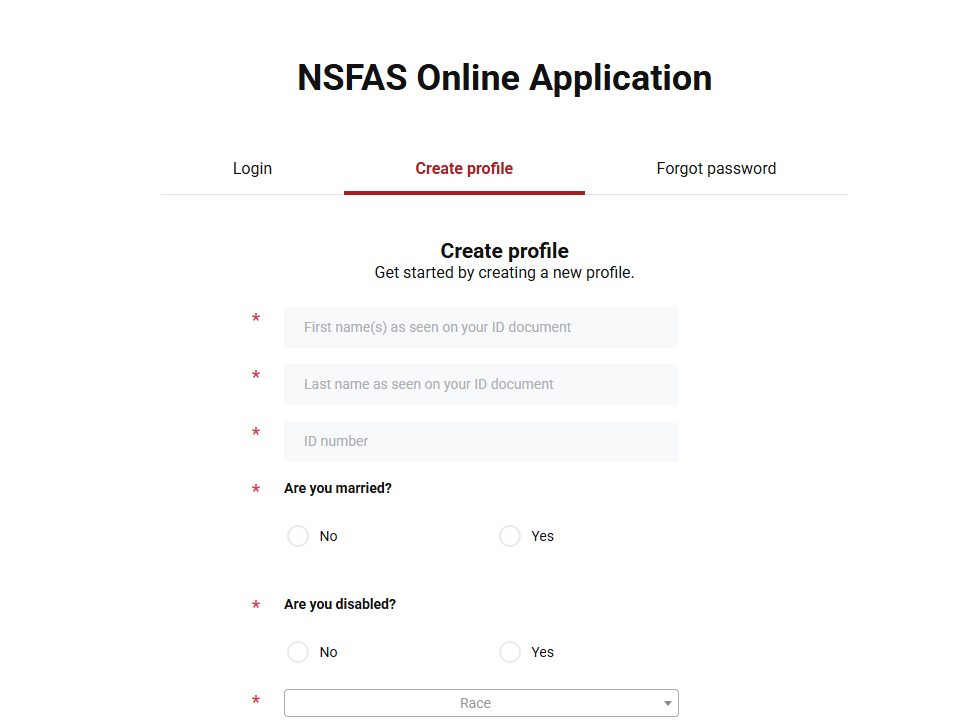
Register using:
- South African ID
- Email address
- Cellphone number
- Secure password
- Security questions
Verify your account using the OTP sent to your phone or email.
Step 3: Complete Your Application
Fill in:
- Personal details
- Household income
- TVET college
- Course
- Contact information
Check every detail carefully before continuing.
Step 4: Upload Supporting Documents
Upload clear certified copies in PDF format.
Ensure documents are:
- readable
- correctly named
- uploaded in the correct section
Step 5: Review and Submit
Before submitting:
- Review your application.
- Confirm all uploads.
- Double-check your ID number.
- Verify your contact details.
Once submitted, save your reference number immediately.
Step 6: Track Your Application
Submitting your application is only the beginning. NSFAS recommends checking your application status regularly through the myNSFAS portal to stay informed about any updates or requests for additional information.
How to Track Your NSFAS Application
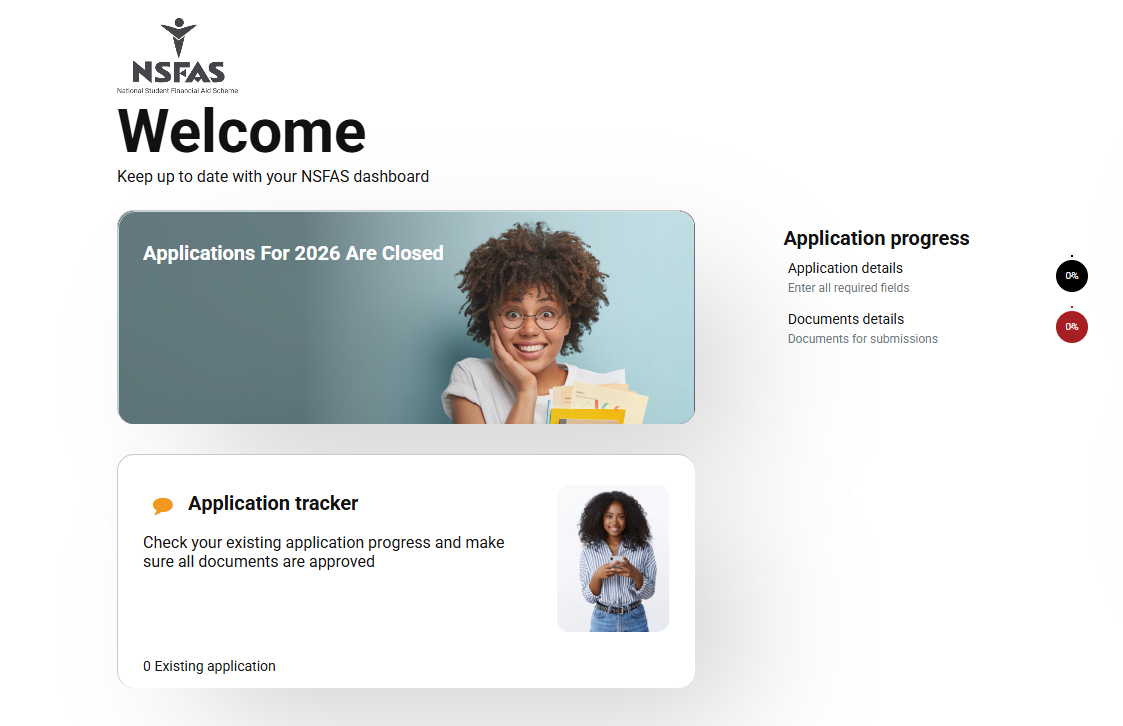
- Visit the official NSFAS website.
- Click myNSFAS in the top-right corner.
- Log in using your registered email address and password.
- Complete the CAPTCHA verification.
- Open the Track Funding Progress or Application Status section.
- View your current application status and check for any outstanding actions.
Understanding Your Application Status
| Status | Meaning |
|---|---|
| Application Submitted | Your application has been received. |
| Documents Missing | Additional documents are required before processing can continue. |
| Under Review | NSFAS is assessing your eligibility. |
| Funding Eligibility | Household income and other qualifying criteria are being verified. |
| Awaiting Academic Results | NSFAS is waiting for your institution to provide academic information. |
| Approved | Congratulations! Your funding has been approved. |
| Rejected | Your application was unsuccessful. You may qualify to submit an appeal. |
NSFAS advises applicants to check their portal regularly because important requests—such as uploading missing documents or accepting funding—may appear there before an email or SMS is received.
My Experience and Practical Insights
After reviewing NSFAS appli one thing stands out:
Most applications are not rejected because students don’t qualify.
Instead, delays usually happen because:
- documents are missing
- documents are blurry
- applicants use someone else’s cellphone number
- household income information is incorrect
- students forget to submit the application after completing it
- applicants never check their myNSFAS portal
The students who have the smoothest experience usually prepare every required document before starting their application and monitor their portal regularly after submission.
Common Mistakes to Avoid
Avoid these common errors:
- Waiting until the closing date.
- Using someone else’s email address.
- Uploading uncertified documents.
- Uploading blurry images.
- Entering incorrect ID numbers.
- Forgetting to save your reference number.
- Ignoring requests for additional documents.
- Using unofficial websites.
- Forgetting to click Submit.
Troubleshooting
I forgot my myNSFAS password
Use the Forgot Password option on the login page to reset your password.
My application says “Documents Missing”
Log into your portal immediately and upload the requested documents.
My application is still under review
This simply means NSFAS is verifying your information. Continue checking your portal for updates.
My application was rejected
Check the rejection reason carefully and submit an appeal within 30 days, together with any supporting documents required.
I entered incorrect information
Update your details through your myNSFAS account if permitted, or contact NSFAS for assistance.
Helpful Tips and Best Practices
- Apply as early as possible.
- Prepare every document before you begin.
- Save digital copies of all uploads.
- Use your own email and cellphone number.
- Write down your password.
- Save your reference number.
- Check your portal at least once a week.
- Respond quickly to NSFAS requests.
- Never share your myNSFAS password with anyone. NSFAS states that its officials will never ask you to disclose your password.
Frequently Asked Questions
1. Who qualifies for NSFAS?
South African citizens or permanent residents studying at public TVET colleges or universities who meet the income requirements.
2. Can SASSA beneficiaries apply?
Yes. SASSA beneficiaries automatically satisfy the financial eligibility requirement.
3. Can I apply without matric?
Yes, provided you meet your TVET college’s admission requirements.
4. How do I track my application?
Log into your myNSFAS account and open Track Funding Progress.
5. What if my application is rejected?
You can submit an appeal within 30 days if you are eligible.
6. Can I change my course?
Yes, before funding has been finalised, subject to NSFAS processes.
7. Can private college students apply?
No. NSFAS only funds approved public universities and public TVET colleges.
8. What happens if documents are missing?
Your application will not proceed until the required documents have been uploaded.
Official Resources and References
For official information, applications, forms, and status tracking, use the following resources:
- NSFAS Official Website
- How to Apply for NSFAS Funding
- South African Government – NSFAS Information
- myNSFAS Portal (available through the NSFAS website)
- Toll-free: 08000 67327
- Email: info@nsfas.org.za
Conclusion
Applying for NSFAS funding could be one of the most important steps toward achieving your education and career goals. While the application process may seem overwhelming at first, careful preparation can make it much easier.
Gather your documents early, complete every section accurately, submit your application well before the closing date, and monitor your myNSFAS account regularly for updates. If additional information is requested, respond promptly to avoid unnecessary delays.
With the right preparation and attention to detail, you’ll give yourself the best possible chance of securing funding for your TVET studies and taking the next step toward a brighter future.
Disclaimer
This guide is for informational purposes only and is based on official NSFAS information, publicly available resources, research, and practical experience. Funding rules, eligibility criteria, application dates, and supporting document requirements may change. Always confirm the latest information through the official NSFAS website before submitting your application. Approval of funding is subject to NSFAS’s assessment and applicable policies.

.
About Pheto M
Pheto M is the founder and guide writer of HowToGuide.co.za, a practical information website created to help people find clear, useful and easy-to-understand guidance on everyday topics.
Pheto started HowToGuide.co.za after noticing a common problem: people often need help with important questions, applications, services and everyday decisions, but the information available online can be confusing, difficult to understand or scattered across different sources.
Pheto has experience and knowledge across several areas, including Business, Information Technology (IT), Education and Relationships. These areas have given her a practical understanding of different challenges people face in their personal, professional and everyday lives.
Today, she dedicates her time to researching, writing and updating practical guides designed to help readers understand information and take the right steps with greater confidence.
Her approach is simple: make complex information simple, confusing processes clear, and difficult situations easier to manage.
Through HowToGuide.co.za, Pheto aims to provide practical, accessible and helpful information that readers can use in their everyday lives.
Pheto values feedback from readers and is committed to continually improving the content on HowToGuide.co.za. If you have a question, suggestion, or would like to get in touch, you can email her at admin@howtoguide.co.za. She personally reviews reader feedback and aims to respond within 48 hours.
Limpopo Online Admission Status Check 2027: Step-by-Step (Grade R,1& 8)
September 2, 2026
Reading Time: 9 minutesApplications for Limpopo Online Admissions 2027 are officially closed. Learn how to log into the portal, track your child’s application progress, check placement status, and resolve common login issues.
ACTOM EHS Internship 2026: Requirements & Application Guide. Closed on 31 August 2026
August 9, 2026
Reading Time: 9 minutesLooking to start your career in Environmental, Health, and Safety (EHS)? Explore the ACTOM Power Transformers EHS Internship 2026 in Wadeville. Learn about qualification requirements, key responsibilities, necessary application documents, and step-by-step instructions on how to apply before the 31 August 2026 closing date.
How to Register for Gauteng School Admissions Grade 1 & Grade 8 Online (2027)
August 5, 2026
Reading Time: 5 minutesLearn how to register for Gauteng school admissions (Grade 1 & Grade 8) online for 2027. Step-by-step GDE portal guide, required documents, and practical tips.
How to Register for SACE Online in South Africa (2026): Complete Step-by-Step Guide
August 4, 2026
Reading Time: 6 minutesLearn how to register for SACE online in South Africa. Follow our 2026 step-by-step guide on eServices, required documents, fees, and application steps.
Limpopo Online Admissions 2027: How to Apply for Grade R,1 & 8 (Step-by-Step Guide): Closed 31 August 2026
July 26, 2026
Reading Time: 6 minutesA complete step-by-step guide on how to apply for public school placement using the Limpopo Department of Education Online Learner Admissions System (OLAS) for the 2027 school year. Learn about opening and closing dates, required documents, registration steps, and common mistakes to avoid.
UIF Graduate Internship Programme (2027-2029): How to Apply for 109 Internship Opportunities. Closed
July 25, 2026
Reading Time: 4 minutesApply for the UIF Graduate Internship Programme 2026 (109 Posts). Earn an R8,174.75 monthly stipend. Get application emails, Z83 details, and step-by-step instructions before 7 August 2026.
How to Negotiate a Higher Salary in 2026: A Step-by-Step Guide
July 21, 2026
Reading Time: 5 minutesFeel like your hard work and loyalty are going unrewarded? Discover 5 step-by-step strategies to research your market value, prepare a convincing pitch, and negotiate a higher salary or better benefits package with confidence in 2026.
ATNS Graduate in Training Programme 2026 (24-Month Paid Internship): Closed
July 15, 2026
Reading Time: 5 minutesApply for the ATNS Graduate in Training Programme 2026. Discover 24-month paid graduate opportunities in Business, Logistics, Aviation Security, Information Management, and OHS based in Johannesburg. Closing date: 28 July 2026
Seriti Engineering Learnership 2026 (NVC071/26GS): Apply Online:Closed
July 13, 2026
Reading Time: 5 minutesWant to launch your engineering career in the mining sector? Apply for the Seriti Engineering Learnership 2026 (Reference: NVC071/26GS) at New Vaal Colliery. Discover the minimum N2/Grade 12 requirements, available trades (Diesel Mechanic & Auto Electrician), and follow our step-by-step application guide before the closing date on 21 July 2026.